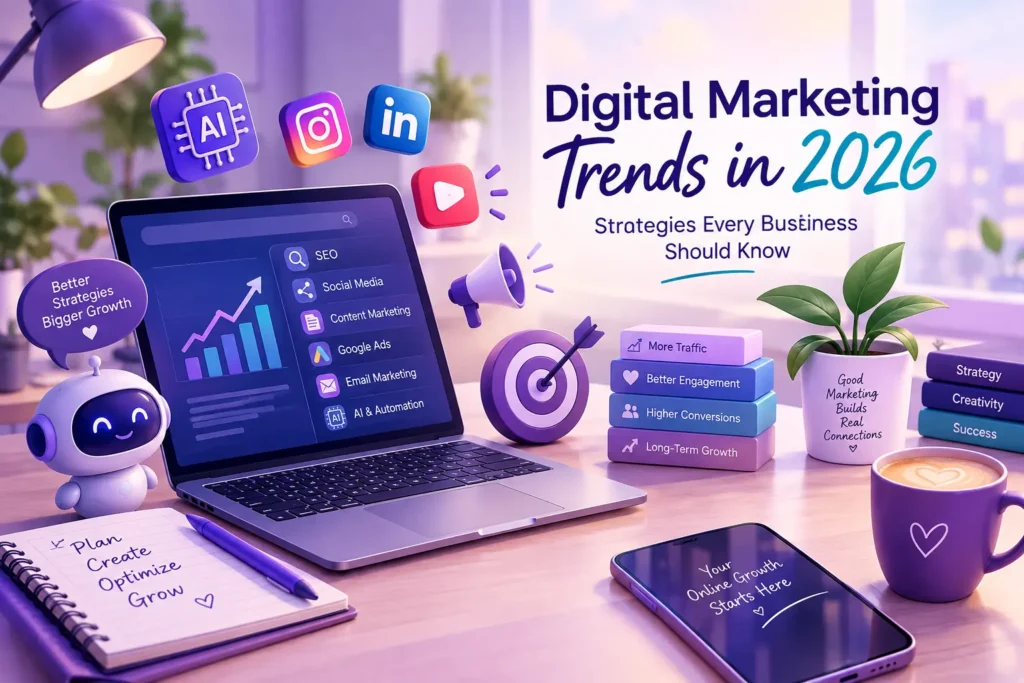
“Digital Marketing Trends in 2026: Strategies Every Business Should Know”
The world of digital marketing keeps evolving at a very fast rate. The technologies, consumer behavior changes, AI, and social media trends keep changing the face of how businesses engage with their audience. By 2026, just creating a website or maintaining a presence on social media is not enough for any business to be visible and relevant. They have to adopt new strategies, create valuable content, deliver great customer experience, and go for data-driven marketing. If you are working for a small business, startup, or an already established company, learning about the trends in digital marketing in 2026 may prove to be useful for making better marketing decisions. What is Digital Marketing? Digital marketing is a process of promotion of a business, product or service using digital channels including search engines, social media networks, websites, e-mails, online advertisements, and content channels. The Latest Digital Marketing Trends in 20261. AI-Based Marketing AI has become a significant feature of modern digital marketing as businesses use AI to understand customers, generate content ideas, analyze data, and automate routine marketing tasks. AI can be used by marketers to detect behavioral patterns and make quicker and more informed decisions. Nonetheless, human ingenuity and reasoning skills will still play a key role in marketing. The right strategy would be to leverage AI but at the same time preserve authenticity and usefulness of the content. 2. SEO Is Getting Increasingly User-Centric SEO remains an important part of digital marketing. Nonetheless, modern SEO goes far beyond keyword stuffing on a page. Today, search engines prioritize user-centeredness of a page. For companies in 2026, the emphasis should be put on: Useful and unique contentSearch intentWeb performance and speedMobile optimizationSite architectureKeywordsInternal linksGood user experience An effective SEO plan will assist in making a company more visible and attracting potential customers who are looking for its products/services. 3. Social Media Marketing Becomes Increasingly Interactive Social media marketing is now becoming increasingly interactive instead of merely gathering followers. Short videos, story features, polls, comments, live posts, and community-centric content allow brands to establish greater connections with their audiences. Brands need to select channels according to the presence of their targeted consumers instead of being present on all possible networks. Regular and consistent use of social media marketing will help brands increase awareness, engagement, and communication. Interactive social media marketing is the future of social media marketing in the year 2026.Marketers have been using short videos, polls, stories, live sessions, and interactive content to engage customers. Companies are no longer limited to selling goods; rather, they are making content that initiates dialogue. Comments, shares, likes, and direct messages are ways of knowing what the audience wants from the brands.Moreover, interactive content can make the brand appear more relatable and friendly.Companies should concentrate on developing unique content tailored for their target audience. Consistency in social media can aid in the success of the company through increased brand awareness and customer engagement. 4. Short Videos Content The short videos remain a great way to convey information fast. Companies can leverage short videos for the following purposes: Product launch Offering tips Answering frequently asked questions Behind-the-scenes footage Service explanation Customer experience Brand storytelling What really matters is not only to create videos but also to make them meaningful and interesting. 5. Content Marketing is About Providing Value Content marketing is still relevant as a digital marketing strategy, but people are getting choosier with what they want to be exposed to. Rather than developing content purely for the sake of doing so, it would make sense for brands to address their customers’ questions and issues. Some forms of valuable content include: Blogs Guides Videos Infographics Case studies Social media posts FAQs Learning materials Content marketing can also help with SEO, social media, lead generation, and branding simultaneously. 6. Personalized Customer Experiences The customers wish to see that the company understands their interests and requirements. Personalization may be used in emails, web experience, advertising, product suggestions and customer communication. For instance, companies can offer product suggestions or content depending on previous customer interactions. The purpose is to make the communication as relevant as possible without creating an unpleasant feeling for the customer. 7. Data-Based Digital Marketing Data is a critical element in determining whether the marketing campaign has any impact. It becomes possible for organizations to measure their results in terms of: Website visits Interaction Conversion ratio Qualified leads CTR Customer acquisition costs ROI of the advertisement Understanding the Behavior of Customers Targeting the Appropriate Audience Measuring Marketing Efforts Taking Smart Decisions Improving Ad Budget Utilization Optimizing the Campaigns Boost Rather than making assumptions, marketers have something tangible to work with in order to identify success factors and areas for improvement. 9. Email Marketing Still Has Its Uses Email marketing is still useful for companies in terms of communication, despite the rise of social media and other forms of marketing. This can be used by companies for: Newsletter distribution Promotions and discounts Product updates Educational material Contacting customers Building leads It is essential that emails sent to subscribers are relevant. 10. Google Ads and Performance Marketing Advertsing with payment can assist companies in finding customers faster. Services like Google Ads offer an opportunity to target potential customers depending on the searches, interests, location, and other aspects. Nevertheless, advertising without planning may turn out to be costly for businesses. Therefore, companies must set their objectives, choose a right target audience, build relevant landing pages, and constantly measure campaign performance. Google Ads and performance marketing provide an opportunity for businesses to get in touch with potential customers in time. Companies will be able to pay for campaigns in order to display ads on different digital platforms, including search results and websites. Choosing the right keywords, targeting a correct audience, and creating ad campaigns that bring benefits to companies will allow businesses to generate traffic and conversions more efficiently. By 2026, effective performance marketing will not be about the ability of companies to run advertisements, but to analyze and optimize