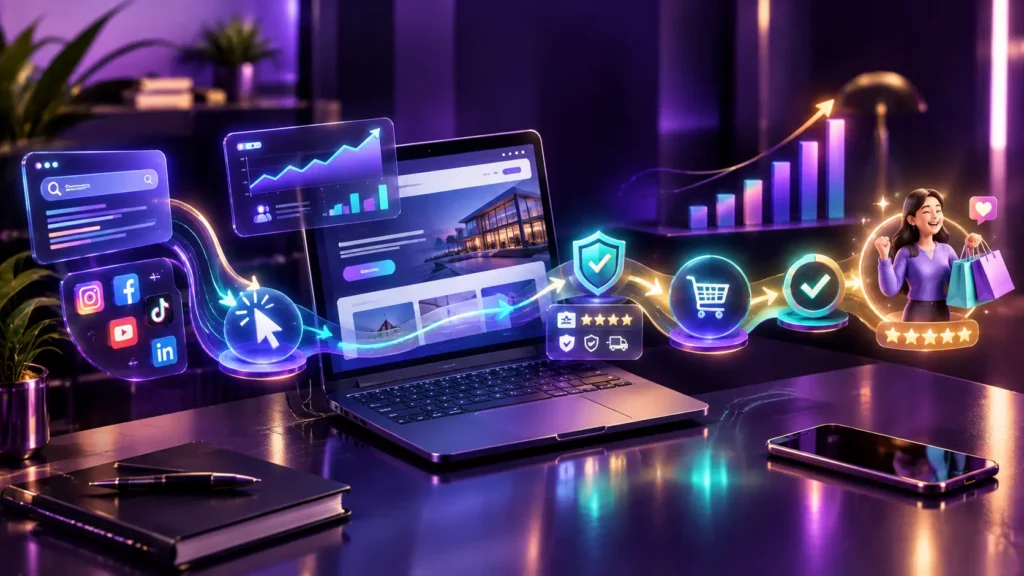
Why Some Brands Get Clicks While Others Get Customers
Digital Marketing Strategy Why Some Brands Get Clicks While Others Get Customers Clicks are attention. Customers are action. Here’s what actually happens in the gap between the two — and how to close it. Every business owner knows the feeling. Your website traffic is climbing. Your ads are getting clicked. Your social posts are getting likes and shares. On paper, things look good. Then you check your sales numbers, and they don’t match the excitement. This is one of the most common frustrations in digital marketing: strong activity, weak results. It’s not because the marketing failed completely — it’s because clicks and customers are not the same thing. Clicks are attention. Customers are action. And the brands that consistently grow online have figured out how to move people from one to the other. In this article, we’ll break down why clicks vs customers is such a common gap, what causes it, and what businesses can actually do to close it — without relying on gimmicks or unrealistic promises. Clicks Are Not the Same as Customers Before fixing the gap, it helps to understand the stages between them. A person doesn’t go straight from seeing your brand to buying from it. They move through several steps, and each one has a different meaning: Impressions — how many times your content or ad was seen Clicks — how many people acted on curiosity and visited your site Website traffic — the overall volume of visitors, from all sources Engagement — time on page, scrolling, interacting with content Leads — people who share contact details or show buying interest Conversions — people who take the action you want, like a purchase or booking Customers — people who actually pay for your product or service A simple example makes this clearer. Imagine a local bakery running Google Ads for “fresh cakes near me.” The ad gets clicked 200 times in a week. That’s 200 people curious enough to look. But if the landing page is slow, doesn’t show prices, or has no way to place an order easily, most of those 200 will leave without buying anything. High traffic, low sales — not because the product is bad, but because the journey after the click didn’t hold up. Why People Click but Do Not Buy There isn’t usually one single reason conversions stay low. It’s often a combination of small gaps that add up. Here are the ones we see most often. The Brand Is Attracting the Wrong Audience Traffic volume feels good, but volume without relevance rarely turns into sales. If your SEO for businesses or paid ads are pulling in people who were never likely to buy — wrong location, wrong budget, wrong need — no landing page in the world will convert them. Targeting the right audience matters more than reaching the biggest one. The Landing Page Does Not Match the Ad or Search Intent If someone clicks an ad promising “affordable web design” and lands on a generic homepage with no mention of pricing or web design at all, they’ll bounce. Message consistency — between what was promised and what’s delivered — is one of the simplest ways to protect your digital marketing conversion rate. There Is Not Enough Trust People rarely buy from a brand they don’t trust, especially online where they can’t see or touch the product first. Missing reviews, no testimonials, vague “about us” information, or a website that looks outdated all chip away at brand trust before a visitor even reaches the pricing page. The Website Experience Creates Friction Confusing navigation, slow load times, a poor mobile layout, or a contact form with too many fields — each of these is a small obstacle. On their own they might seem minor, but together they’re often the real reason a visitor leaves without converting. The Call to Action Is Weak Visitors need a clear next step. Not five options buried in a menu, but one obvious action: “Book a consultation,” “Request a quote,” “Get started,” “Download the guide.” A page with no clear call to action is asking the visitor to figure out what to do next — and most won’t bother. What Makes a Click Turn Into a Customer? The flip side of the problems above is a set of factors that consistently improve conversion. The Right Message Messaging that speaks directly to the visitor’s problem, need, or goal performs better than messaging that talks only about the brand. People respond to “here’s how we solve X,” not “we’ve been in business since Y.” The Right Audience Reaching people who are actually looking for what you offer — based on intent, not just demographics — is the foundation of any customer conversion strategy. This is why intent matters as much as interest. A Strong Value Proposition Why should someone choose your business instead of the next search result? A clear, specific answer to that question — not a vague claim like “best quality” — gives visitors a real reason to stay and act. Trust and Social Proof Genuine reviews, case studies, client testimonials, certifications, and transparent pricing all reduce hesitation. Trust doesn’t need to be flashy — it needs to be visible and honest. A Friction-Free Customer Journey Every extra step, every unclear instruction, every slow-loading page is a chance for a visitor to give up. Simplifying the path from “interested” to “done” is one of the highest-value things a business can invest in. How Digital Marketing Channels Work Together One of the biggest misconceptions in online marketing is that a single channel should carry the whole job. In reality, conversions usually come from several channels working together as part of one connected digital marketing strategy. SEO Brings Intent-Driven Traffic People searching on Google are already looking for something. Strong SEO puts your business in front of them at the exact moment they’re ready to explore — which is why organic search often produces higher-quality leads than colder traffic sources. Social Media Builds Attention and