Introduction
How people look for information, on the internet is changing. In 2026 people find businesses through Google search results AI‑powered search experiences, social media and other digital platforms. For businesses this opens new chances to reach potential customers and build a stronger online presence.
One important question remains: How can a small business get found on Google when AI is changing the search experience?
The answer begins with a SEO foundation, useful content, a technically accessible website and a clear understanding of customers.
At NovaDigi.info we believe that digital growth comes from combining creativity with sustainable strategies. In this guide we will explore how small businesses can improve their search visibility adapt to AI‑powered search and attract the audience in 2026.
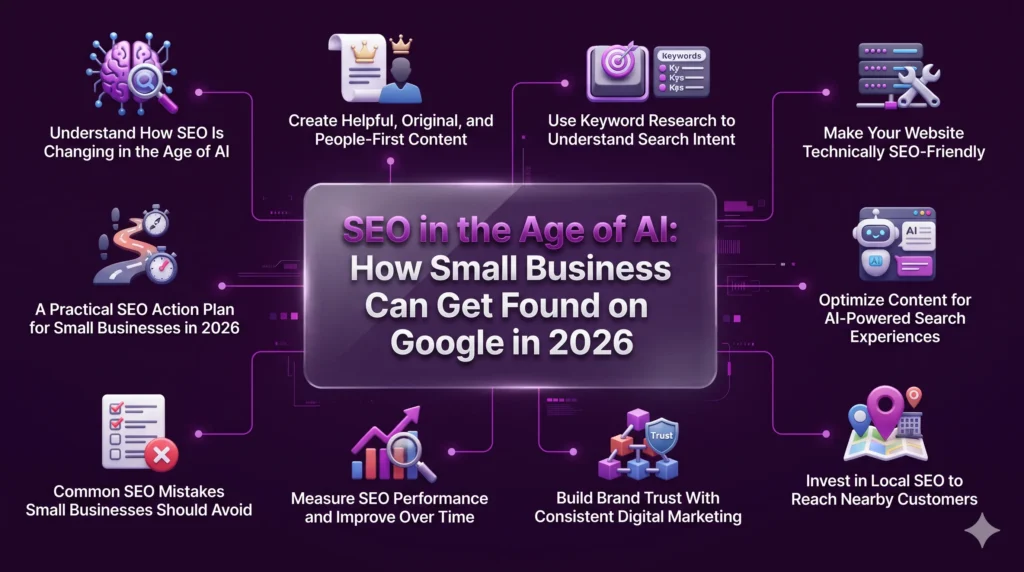
1. Understand How SEO Is Changing in the Age of AI
Search Engine Optimization (SEO) is the process of improving a website so that search engines can understand what the content is about and help people find the pages. In the past businesses paid a lot of attention to keywords, backlinks, website design and search rankings. These basics are still important.. Now with the rise of artificial intelligence things are shifting.
Googles AI Overviews and AI Mode are examples of how search experiencesre changing. Of just showing a list of links these AI tools can give users a quick summary of information and then point them to trusted websites.
For businesses this shift means content must do more than just include popular keywords. Your website should actually answer questions. It should offer information and make it clear why your business is a good fit for the problem someone is trying to solve.
Google has said that the SEO best practices still work. There is no set of rules for getting into AI Overviews or AI Mode. The guidance is the same, as before.
So the main idea stays the same: Help people first. Make your site easy for search engines to find and understand. If you focus on people search engines will follow.
2. Create Helpful, Original and People-First Content
Content is one of the important parts of a long term SEO strategy.. Publishing more articles does not automatically mean higher rankings. Small businesses should create content that addresses the audiences needs, questions and challenges.
For example a local bakery could publish an article about choosing the cake for different occasions. A digital marketing agency could explain how SEO differs from Google Ads. An accounting firm could create a beginner‑friendly guide to organizing business finances.
Each article should offer something to the reader.
Here are a few ways to improve your content:
Answer the question clearly near the beginning.
Use language that your audience understands.
Include relevant examples, practical steps or original insights.
Organize information using headings and short paragraphs.
Support factual claims, with sources where appropriate.
Review existing content and update content when information changes.
AI writing tools can help with research coming up with ideas and fixing mistakes. They cannot take the place of being correct being creative or using smart thinking. Making a lot of copy that’s the same and not useful can break Googles rules, about spam if the goal is to change how websites show up in search results.
At NovaDigi we say it is better to focus on writing things that really help people of putting out articles just to use more words that might help with search engines.
3. Use Keyword Research to Understand Search Intent
Keywords help you see what people are looking for. Picking them needs more than just finding popular phrases.
You also need to understand search intent, which’s the reason behind a users search.
For example consider these searches:
– “What’s SEO?”. The person wants to learn.
– “Best SEO strategies for small businesses”. The person is researching solutions.
– “SEO agency for small business”. The person may be looking for a service provider.
– “NovaDigi marketing services”. The person wants to learn about a particular brand.
Each search shows a need so the content should match that need.
To build a keyword strategy:
– Identify the products, services and topics that are most relevant to your business.
– Research the questions and phrases that your potential customers use.
– Group related keywords by topic and by search intent.
– Create a page or article, for each major user need.
– Use the primary keyword naturally in the page title, main heading, introduction and relevant sections.
– Avoid forcing the phrase into every paragraph. Search engines can understand language and readable content gives visitors a better experience
4. Make Your Website Technically SEO-Friendly
great content requires a website that search engines can find and understand.
Technical SEO deals with the, behind-the-scenes parts that help search engines crawl, index and use a website.
Small businesses should review the following areas.
Website. Indexing
Check if the important pages of a website can be crawled and indexed. Use Google Search Console to spot indexing problems. Look at each URL. Submitting a sitemap can help Google find pages but it does not promise that the pages will be indexed.
Mobile-Friendly Design
A website should work well on smartphones, tablets and desktop computers. Visitors should be able to read the content explore services and contact the business without any difficulty.
Page Experience and Performance
Improve how fast a website loads, cut out elements optimize images and test the important pages often.
Website Structure and Internal Links
Keep your website organized into logical sections. Connect pages that are related using links that make sense to readers. For example if you have a blog post about AI SEO link to your SEO services page or another article that talks about SEO. This helps visitors find information and guides search engines to understand your site better.
Structured Data
Adding data to your website can help search engines read your content more clearly. It might also make your pages eligible for features in search results. Use schema markup that matches your content and follow Google’s guidelines. Remember structured data is not a must for your pages to show up in AI Overviews or AI Mode. It does not guarantee visibility.
Technical SEO is not about making your site harder to manage. It is, about removing roadblocks so both people and search engines can understand your content without confusion.
6. Invest in SEO to Reach Nearby Customers
For businesses that serve a specific city or region local SEO can be especially useful.
Imagine a person looking for a dentist, salon, restaurant or marketing agency near them. A maintained local presence can help eligible businesses show up in local search results.
Here are key local SEO practices:
Create and keep a Google Business Profile if your business is eligible.
Keep your business name, address, phone number and opening hours accurate.
Choose business categories and explain your services clearly.
Encourage customer reviews and respond in a professional manner.
Create website content that is specific, to your location when it helps customers.
Ensure your website gives contact details and service information.
Do not create locations or duplicate location pages that have little unique value.
Local SEO works best when your online information reflects the business and makes it easy for customers to take the next step.
7. Build Brand Trust With Consistent Digital Marketing
Search visibility is one piece of digital growth. Customers also need reasons to trust your business. A steady digital marketing plan helps your brand speak clearly across your website, search results, social media and ads.
For businesses that might mean:
Search Engine Optimization: Grow your natural online presence with helpful content and solid website practices.
Social Media Marketing: Share posts, show what you offer and connect with people who matter to your business.
Content Marketing: Write guides, blogs and helpful resources that answer the questions your customers have.
Google Ads: Get in front of the people with paid campaigns especially when it fits your goals and budget.
Website Optimization: Make sure visitors can easily learn about your services reach you or ask for a quote.
These tools can work together. The best mix depends on your audience, your field and what you can handle.
For example a business that wants leads might try a well-run paid ad campaign while also working on long-term SEO. Another might focus on SEO, useful blog posts and regular social media updates.
The goal isn’t to be, on every platform. It’s to pick the ones that actually help your business grow.
8. Measure SEO Performance and Improve Over Time
SEO is a process, not a one-time task.
Measuring performance helps you understand which pages attract visitors what people are searching for and where your website needs improvement.
Google Search Console can help you monitor search impressions, clicks, search queries, indexing and other aspects of your websites performance.
Depending on the reports to your property you may also be able to review performance from Googles generative AI search experiences.
Google Analytics can help you understand how visitors interact with your website after arriving.
Consider monitoring these metrics:
Organic clicks: How many visits arrive from search.
Search impressions: How often your pages appear in search results.
Click-through rate (CTR): The proportion of impressions that result in clicks.
Conversions: actions such as enquiries, calls, sign-ups or purchases.
Engagement: How visitors interact with your content and website.
Search queries: The terms that help people discover your pages.
Do not judge your SEO strategy by one keyword or a temporary change, in traffic. Review trends, focus on business outcomes. Improve pages based on evidence.
9. Common SEO Mistakes Small Businesses Should Avoid
It is easy for businesses that have intentions to waste time and money on SEO methods that do not work well.
Here are some mistakes that should be avoided:
Keyword Stuffing: Using many keywords in a way that feels forced can make the content hard to read and does not ensure better rankings.
Publishing Thin Content: Pages that do not have useful information will not provide a good experience for visitors.
Ignoring Technical Problems: Important pages might be hard to find if the crawling, indexing or internal linking is not set up correctly.
Buying Links: Using link schemes can go against Googles rules and put the visibility of the website in danger.
Expecting Instant Results: Organic SEO usually needs effort and the results depend on many different things.
Chasing Every AI Trend: New words and tools can be helpful. They should not take the place of the basic methods that have been proven to work.
Ignoring Business Goals: Getting traffic is not always good if it does not bring in the people who need the services.
A smart and steady plan is usually better, than fixes that promise fast success.
10. A Practical SEO Action Plan for Small Businesses in 2026
Getting started doesn’t mean you have to do everything at
Take it one step at a time.
Use this checklist to focus your energy where it matters most.
First review your website.
Check your important pages.
See how your site works on phones and tablets.
Make sure search engines can find your pages.
Look at your page titles and headings.
Check that your contact info is up to date.
Follow your links to make sure they work and make sense.
Next understand your customers.
Think about what they search for.
Look at the questions they ask.
Find out what your current website misses.
Fill in those gaps.
Then improve your pages.
Make your service descriptions clearer and more helpful.
Tell people what you offer and why it matters to them.
Add calls to action. Like “Call now” or “Get a quote.”
After that publish content.
Write blog posts.
Answer customer questions.
Link those posts to your service pages.
This helps people find what they need and keeps them on your site longer.
Strengthen your presence.
Keep your business profiles updated. Google, Facebook, Yelp and others.
Use the name, address and phone number everywhere.
Share content, on channels if it makes sense. Social media, email or local directories.
Finally,. Refine.
Look at how your site’s doing every few weeks.
Update old content that’s no longer useful.
Put effort into the things that actually bring in customers.
You don’t need to do everything away.
Start with the changes that will help your customers the most.
Small steps add up.
Just keep moving.
Conclusion
Make Your Business Easier to Find With NovaDigi
The age of AI is changing how people discover information.. The purpose of effective SEO stays the same: to help the right people find useful, relevant and trustworthy information.
Small businesses can strengthen their presence in many ways. By creating content improving technical SEO understanding search intent investing in local visibility and measuring what matters they can see big results.
You do not need to follow every trend or use every tool. You need a strategy that connects your business goals with your customers needs.
At NovaDigi we bring creativity, innovation and digital marketing strategy together to help businesses build a foundation for online growth.
From SEO and content marketing to media management Google Ads and website optimization NovaDigis goal is to help your brand communicate its value and reach the right audience. Build your presence with NovaDigi. Where creativity meets digital growth.
Ready to Grow Your Business Online?
Explore NovaDigis digital marketing services at NovaDigi.info. Take the next step, toward a stronger online presence.
Frequently Asked Questions
1. Is SEO still important in 2026 with the rise of AI?
Yes. Googles official guidance says that SEO best practices still matter for AI search. Good content, easy technical setup and clear site structure still count.
2. How can a small business improve its Google ranking?
Start by making content. Find the keywords. Fix any SEO problems. Add internal links. Check results with Google Search Console. No way to promise a rank.
3. What is AI SEO?
AI SEO means using AI tools with SEO work. It can help find content topics make content better fix technical SEO and watch how visible a site is in AI search.
4. Do businesses need separate SEO for Google AI Overviews?
Google says small businesses do not need a SEO plan for Google AI Overviews. Stick, to SEO rules and make content that helps people.
5. Can AI-generated content rank on Google?
AI‑generated content is helpful when it is accurate original and designed to assist people. We see that AI‑generated content works best when it is useful and genuine. If automation is used to game search rankings or to produce many low‑value pages it may break Google’s spam rules.
6. How long does SEO take to show results?
The time needed for SEO to show results depends on competition the health of a website, the quality of content the authority of the site and many other factors. We notice that SEO is a journey so businesses should view SEO as a long‑term investment instead of waiting for a fixed date with guaranteed results.
7. What SEO tools should small businesses use?
Good starting tools include Google Search Console for seeing how a site performs in search and, for checking indexing. Google Analytics helps track how visitors use a website and Google Keyword Planner assists with researching keywords. We recommend beginning with these tools if you’re a small business. Other tools can be useful depending on what a business needs and how much it can spend.