The Psychology Behind Every Click: What Makes People Buy Online
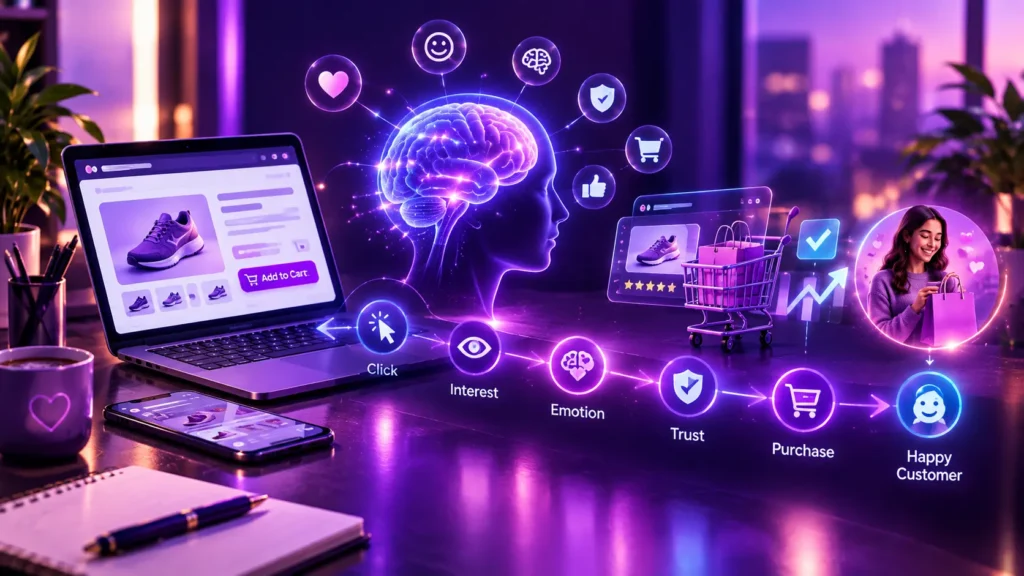
The Psychology Behind Each Click: Why Do People Make Purchases on the Internet? Ever wondered how people get to some website, see some products there, click a button and suddenly make a purchase? It seems to be a single click. But behind this click, there is a blend of such factors as *emotion, trust, curiosity, convenience, design and human psychology*. People do not necessarily make purchases because the products there are cheaper than anywhere else or the company has more functions than others. They make purchases when something is *relevant, trustworthy, valuable and convenient* for choice. And this is the reason why now it has become extremely important to understand consumer psychology. From Google search up to the checkout process everything is a digital touchpoint. At *novadigi.info, we think that great digital marketing goes beyond simply making clicks. It involves knowing why people make clicks and why they move to the next step. The Importance of Psychology in Digital Marketing Digital marketing targets customers at various buying stages. Your customer may start off finding your business on Google, check out your Instagram posts, visit your website, read reviews, compare your product to other options, and eventually purchase your product. Each one leaves an impression. Thus, effective digital marketing requires you to ask yourself not only: How can we get more traffic? But also: What do our customers need to experience before making a decision? Once you understand the consumer behavior of your target market, you will know how to approach them without being intrusive. Influences on Internet Purchase Decisions Based on Psychological Factors 1. Trust Before You Buy. The lack of trust in a brand hinders purchase decisions. Prior to making an online purchase, consumers will seek out signs of: * Valid reviews and testimonials* Accurate product/service details* Well-designed website* Secure checkout process* Contact details* Policies The site could have fantastic products but still fail to close the deal because it is untrustworthy-looking. The site could have amazing products, but if it looks suspicious to the customer, he/she will never make a purchase due to distrust. Trust removes doubt and helps to take an action. 2. Emotions are More Important Than Reason in Decision-Making Process. It’s always easy for people to think that their decisions are totally rational, however, emotions play quite a big role in the process. Customers can buy something just to feel: *More confident;*time-saving;*presentable;*release from irritation;*easier life;*something enjoyable.* That’s why good marketing doesn’t concentrate only on product’s advantages, but also on -customer’s feelings- which it provokes. Instead of plain statement: Our service enhances your online presence. The following one sounds much better: Build an online presence which will make it easy to find, trust, and remember your brand. This second message connects the service with a meaningful result for the customer. 3. People Make a Choice on Simplicity Over choice leads to confusion. A website with complex navigation, long forms, confusing buttons, or excessive information might discourage the customer from taking action. Here *simplicity* comes into play. Ensure clear navigation, understandable content, narrow focus on the landing page, and good calls to action. Do not overwhelm the visitor with ten options; rather give him one right direction. Like this: *Discover Our Services → See Results → Contact Us* Simplicity minimizes obstacles. 4. Social Proof Increases Trust. If a customer sees other people using the same product or service, this can add to his feeling of safety. This is Known as social proof. Social proof by brands is achieved via: – Reviews– Testimonials– Case studies– Ratings– User-generated content– Logos– Success stories Let us take an example of two agencies providing the same services. One says: “We provide digital marketing services.” The other provides information in the form of customer experiences, results, and testimonials. Brand number two provides more justification for its clients. 5. Scarcity Can Create Urgency People become more interested when the offer seems to be scarce. Phrases like: -Limited seats-Offer expires soon-Limited spaces create a sense of urgency. Urgency can be effective only if it is legitimate. Artificial scarcity may harm the buyer’s trust, but actual deadline or scarcity may help the buyers who have some level of interest take a decision. 6. Good Design Impacts Perception. Before even getting to your content, users will perceive the design of your website. Layout, spacing, typography, imagery, buttons, color, and hierarchy all play a role in how the visitor perceives the site. Good design can convey: *Professional → Trustworthy → Modern → Valuable* whereas poor or outdated design might cause hesitation. Design doesn’t eliminate the need for effective marketing, but it can influence how people perceive your message. This is the reason why you need to make sure that your website looks nice and still functions well. 7. People Want to Be Understood. One of the most important psychological approaches used in marketing is that of relevance. It is much easier for customers to relate to something that addresses their issues directly. Don’t write about all that your company does – tell them why they need it. For instance: Finding it difficult to make yourself seen online? This directly addresses a potential customer’s problem. Then you can proceed with explaining how SEO, content marketing, SMM, Google ads or other services can help them solve this problem. 1-Psychology of the Customer Journey A customer’s decision process does not typically take place in one single click. It might resemble something like this: *Discover → Explore → Evaluate → Trust → Act → Purchase* 2-Discover First, the customer discovers his needs or problems. Search Engine Optimization (SEO), social networks, ads, and other types of marketing will get your brand noticed during this step. 3-Explore The customer visits your site, explores your services, consumes your content, looks for additional info. Here you should create an experience which would be helpful and understandable for a customer. 4-Evaluate At this point, a customer evaluates all available choices. Benefits, clear pricing information, FAQ section, reviews, case studies, and high-quality content can minimize customers’ fears.