From Scroll to Chat to Cart: How AI Is Changing the Customer Journey in 2026
From feed discovery to instant messaging and streamlined checkout: AI connects every touchpoint of the modern customer experience.
Think about your last online purchase. Did you sit at a desktop computer, type a product name into search, click the first link, and buy immediately?
Probably not.
More likely, your journey began while scrolling through your feed. You paused on a 15-second creator clip demonstrating a solution to an everyday problem. You skimmed comments, tapped a profile link, and watched a follow-up video. Later, an interactive message on WhatsApp answered questions about sizing and delivery. Before bedtime, you finalized the order in two quick taps.
For business owners, this shift is profound. The traditional buying funnel—the predictable **Search → Website → Purchase** sequence—has dissolved. Today, the modern buyer follows a fluid path:
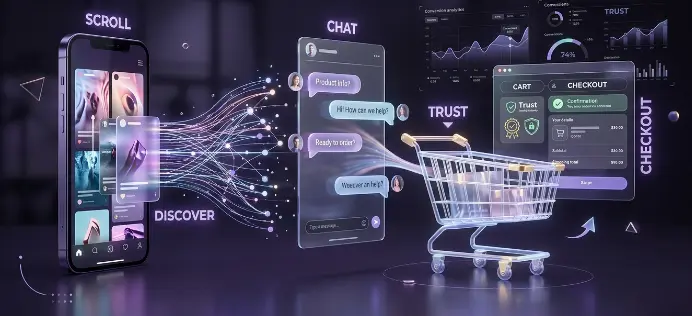 At the center of this transformation is the **AI customer journey**. As we analyze key **AI marketing trends 2026** brings to digital commerce, artificial intelligence connects the dots across social media feeds, search engines, messaging apps, and checkout pages. Understanding how this connected journey works is essential for business growth.
The Customer Journey Is No Longer Linear
The **customer journey in 2026** is fluid, decentralized, and multi-directional. A buyer might discover your brand on Instagram Reels, watch a creator breakdown on YouTube Shorts, search your company on Google, read community reviews, ask questions via WhatsApp, and convert through a targeted email reminder.
Shoppers discover, evaluate, and trust brands across diverse touchpoints:
- Instagram Reels and YouTube Shorts
- Creators and community reviewers
- Targeted social ads
- Search engines and AI answer overviews
- WhatsApp and direct messaging conversations
- Reviews and authentic user-generated content
Consumers move between platforms before purchasing. Rather than expecting buyers to follow a rigid path, forward-thinking brands use **AI-driven marketing** to build responsive touchpoints that support prospects wherever they interact.
From Scroll to Discovery — AI Is Changing What Customers See
Discovery is no longer driven purely by search queries. AI recommendation systems predict consumer interest, introducing products before a shopper even thinks to search for them.
Personalized Recommendations Algorithms analyze engagement signals—including watch time, repeat loops, and comments. Through sophisticated **AI personalization**, recommendation engines surface content tailored to individual lifestyles, helping brands connect with high-intent audiences with precision.
Short-Form Video and Creators Short-form video is the gateway to modern discovery. When creators share authentic demonstrations or practical tips, they compress days of product research into thirty engaging seconds. In 2026, creator partnerships and **short-form video marketing** build buyer trust faster than traditional ads. This shift fuels the rapid rise of **social commerce**, where algorithmic feeds function as curated storefronts.
Social Ads and Brand Visibility Organic reach alone rarely scales. Modern ad networks evaluate behavioral signals to display targeted offers. By connecting strategic [Internal Link: Paid SMM] campaigns with broader [Internal Link: Social Media Marketing] efforts, businesses place timely offers in front of users who have engaged with educational video content.
From Discovery to Chat — Why Conversations Matter
Discovery sparks curiosity, but hesitation follows. Questions about sizing, compatibility, delivery timelines, or return policies cause buyers to pause.
In 2026, buyers rarely fill out static forms or wait days for email replies. They expect instantaneous, conversational clarity before spending their money.
AI-Powered Conversations Modern **conversational commerce** uses intelligent chat assistants to answer common product inquiries, recommend matching items, and guide selections around the clock. However, automated tools work best with human oversight. Chat assistants should handle routine questions swiftly while allowing complex inquiries to transition smoothly to experienced team members.
WhatsApp and Conversational Commerce For businesses in India and emerging markets, WhatsApp has evolved into a primary commercial channel. Direct messaging allows customers to explore product catalogs, ask questions, receive curated suggestions, and complete transactions inside a single chat window, bridging the gap from **social media to sales**.
From Chat to Cart — How AI Can Reduce Purchase Friction
When a customer is ready to buy, friction must be minimal. Modern **AI-powered shopping** workflows streamline checkout through practical tools:
- **Contextual Product Comparisons:** Smart widgets help shoppers evaluate options without leaving the product page.
- **Smart Offer Suggestions:** Automated systems suggest relevant bundles or free shipping thresholds right when hesitation occurs.
- **Predictive Retargeting:** Coordinated campaigns through [Internal Link: Google Ads] re-engage visitors with answers to common objections rather than repetitive ads.
- **Frictionless Checkout:** Streamlined mobile payments allow buyers to complete purchases in seconds.
- **Helpful Abandoned-Cart Reminders:** Timely follow-ups via WhatsApp or email address specific hesitations rather than sending generic discounts.
Designing an end-to-end, **AI-powered customer experience** makes purchasing effortless without resorting to aggressive sales tactics.
How AI Is Personalizing the Customer Experience
Delivering a personalized **digital customer journey** means tailoring every stage of interaction based on customer intent. True **personalized marketing** extends far beyond inserting a subscriber’s first name into an email subject line.
Content Using modern [Internal Link: Content Marketing] and flexible [Internal Link: CMS Solutions], brands serve educational guides to first-time visitors while showing returning customers relevant upgrades or reorder options.
Advertising Machine learning optimizes ad creatives and bidding automatically, ensuring prospects see ad messages tailored to their level of brand familiarity.
Recommendations Rather than showing random items, AI suggests complementary products based on actual purchase context—such as suggesting compatible memory cards and cases for a purchased camera.
Follow-Ups Through automated [Internal Link: Email Marketing], businesses deliver helpful onboarding advice, care instructions, and warranty information that build long-term loyalty and enhance the overall **customer experience**.
What This Means for Digital Marketing in 2026
 Digital marketing cannot succeed in disconnected silos. Running social ads without coordinating with your website team or ignoring customer chat leads creates a disjointed experience that confuses prospective buyers.
Success in 2026 requires connecting all key pillars:
**SEO + SMM + Paid Ads + Content + Messaging + Analytics**
When your [Internal Link: SEO Services], social storytelling, paid acquisition, and conversational channels work together, customer interactions feel cohesive and trustworthy.
At **Novadigi.info**, we help businesses integrate these channels into a unified growth engine, ensuring that discovery on social platforms translates directly into qualified leads and sustained revenue.
7 Ways Businesses Can Adapt to the AI-Powered Customer Journey
Adapting your comprehensive **digital marketing strategy** to this new landscape requires practical execution:
1. Create Content That Gets Attention Focus on short-form videos and visuals addressing customer challenges in the first few seconds.
2. Answer Customer Questions Quickly Implement conversational messaging on WhatsApp and website chat to answer pre-purchase questions instantly.
3. Optimize for Search and AI Discovery Strengthen your [Internal Link: SEO Services] with structured data, fast loading speeds, and clear, authoritative answers that AI search engines can cite.
4. Make Paid Campaigns More Relevant Use audience signals and creative testing in [Internal Link: Paid SMM] to reach high-intent prospects with relevant messaging.
5. Connect Social Media With Your Website Ensure every social post and ad leads to a fast, dedicated landing page that delivers on the creative’s promise.
6. Use AI Without Losing the Human Touch Leverage AI for efficiency, but preserve your authentic brand voice and maintain human support for sensitive inquiries.
7. Measure the Full Journey Track the entire path—from initial social impressions and chat conversations to assisted conversions and repeat business.
Common Mistakes Brands Should Avoid
When implementing **AI in digital marketing**, avoid these common pitfalls:
- **Publishing Generic AI Content:** Unedited, robotic articles harm brand credibility and fail to engage readers.
- **Chasing Vanity Metrics:** Video views and likes mean little if they do not lead to conversations or inquiries.
- **Ignoring Direct Messages:** Leaving social inquiries or WhatsApp chats unanswered leads directly to lost sales.
- **Sending Irrelevant Automated Messages:** Spamming users with repetitive promotional messages alienates buyers.
- **Neglecting Landing Page Quality:** Driving expensive ad traffic to slow, confusing web pages wastes marketing budget.
- **Overlooking Fundamental SEO:** Neglecting search optimization leaves you invisible when prospective buyers research credibility.
- **Over-Automating Interactions:** Removing human interaction entirely frustrates customers facing complex buying decisions.
The Future of the Customer Journey
Looking ahead, the customer journey will become increasingly:
**Personalized + Conversational + Connected + AI-Assisted**
Shoppers will discover products through intuitive social feeds, ask questions via conversational AI, and purchase with minimal friction. Brands that build accessible, helpful, and trustworthy digital experiences across all touchpoints will thrive.
Final Thoughts
Customers are not simply moving from search to purchase anymore. They are discovering through feeds, building trust through content, asking questions through conversations, and purchasing through increasingly connected digital experiences.
To succeed, businesses must make every stage of the journey useful, responsive, and trustworthy. Uniting search optimization, engaging content, targeted ads, and conversational messaging creates a seamless path from first glance to checkout.
If you are ready to build a connected marketing strategy, **Novadigi.info** is here to help your business guide customers smoothly from scroll to cart.
Frequently Asked Questions
How is AI changing the customer journey in 2026?
AI replaces the rigid search-to-buy funnel with a fluid, personalized discovery cycle. Recommendation algorithms match users with contextual content, conversational assistants answer pre-purchase questions instantly on channels like WhatsApp, and predictive analytics streamline checkout friction, making every customer interaction tailored to real-time intent.
How does AI help customers discover products on social media?
Social platforms rely on machine learning models that evaluate user engagement signals, dwell times, and visual preferences. Rather than relying solely on keyword searches, AI proactively delivers short-form videos, creator collaborations, and hyper-targeted social ads directly to consumers most likely to find them relevant.
What is conversational commerce?
Conversational commerce enables shoppers to research products, ask questions, receive curated recommendations, and complete purchases directly within messaging channels like WhatsApp, Instagram DMs, or interactive web chat, blending self-service speed with personal brand dialogue.
How can AI help turn social media engagement into sales?
AI bridges the gap between passive scrolling and buying by automating prompt DM responses, surfacing tailored product cards, triggering personalized retargeting ads, and delivering contextual discount codes right when a shopper displays intent during a chat or comment interaction.
Does SEO still matter in an AI-powered customer journey?
SEO is more vital than ever. Modern AI search engines, generative overviews, and recommendation systems depend on structured data, technical speed, and authoritative content. Robust technical SEO and on-page optimization ensure your brand is cited and retrieved across both traditional search and AI answer engines.
How can small businesses use AI in digital marketing?
Small businesses can implement AI by automating customer support FAQs on WhatsApp, generating data-driven content ideas, segmenting email subscriber campaigns, and optimizing paid ad budget allocation, allowing lean teams to deliver enterprise-grade personalized customer experiences.
Your customers are already moving from scroll to chat to cart. Is your marketing strategy ready to move with them?
At Novadigi.info, we help modern businesses connect every touchpoint of the customer journey. From technical SEO and AI discovery optimization to targeted social media marketing, paid SMM, Google Ads, content marketing, email marketing, and high-performance CMS solutions, our integrated digital marketing strategies turn casual interest into loyal relationships.
Request a Strategic Growth Consultation