September 21, 2026

AI 2026

The Psychology Behind Every Click: What Makes People Buy Online

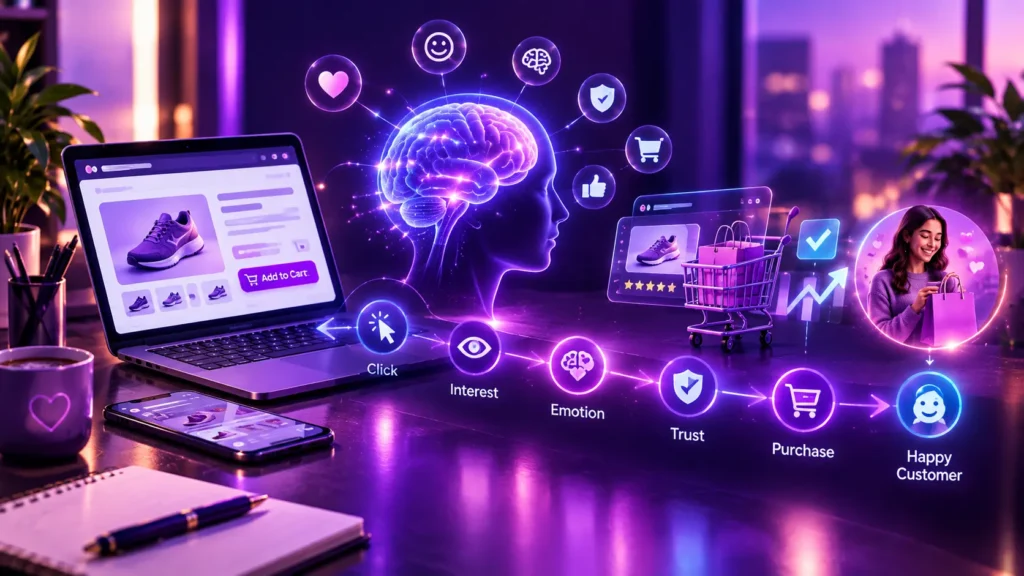
The Psychology Behind Each Click: Why Do People Make Purchases on the Internet? Ever wondered how people get to some website, see some products there, click a button and suddenly make a purchase? It seems to be a single click. But behind this click, there is a blend of such factors as *emotion, trust, curiosity, convenience, design and human psychology*. People do not necessarily make purchases because the products there are cheaper than anywhere else or the company has more functions than others. They make purchases when something is *relevant, trustworthy, valuable and convenient* for choice. And this is the reason why now it has become extremely important to understand consumer psychology. From Google search up to the checkout process everything is a digital touchpoint.  At *novadigi.info, we think that great digital marketing goes beyond simply making clicks. It involves knowing why people make clicks and why they move to the next step.  The Importance of Psychology in Digital Marketing Digital marketing targets customers at various buying stages. Your customer may start off finding your business on Google, check out your Instagram posts, visit your website, read reviews, compare your product to other options, and eventually purchase your product. Each one leaves an impression. Thus, effective digital marketing requires you to ask yourself not only: How can we get more traffic? But also: What do our customers need to experience before making a decision? Once you understand the consumer behavior of your target market, you will know how to approach them without being intrusive. Influences on Internet Purchase Decisions Based on Psychological Factors 1. Trust Before You Buy. The lack of trust in a brand hinders purchase decisions. Prior to making an online purchase, consumers will seek out signs of: * Valid reviews and testimonials* Accurate product/service details* Well-designed website* Secure checkout process* Contact details* Policies The site could have fantastic products but still fail to close the deal because it is untrustworthy-looking.  The site could have amazing products, but if it looks suspicious to the customer, he/she will never make a purchase due to distrust. Trust removes doubt and helps to take an action. 2. Emotions are More Important Than Reason in Decision-Making Process. It’s always easy for people to think that their decisions are totally rational, however, emotions play quite a big role in the process. Customers can buy something just to feel: *More confident;*time-saving;*presentable;*release from irritation;*easier life;*something enjoyable.* That’s why good marketing doesn’t concentrate only on product’s advantages, but also on -customer’s feelings- which it provokes. Instead of plain statement: Our service enhances your online presence. The following one sounds much better: Build an online presence which will make it easy to find, trust, and remember your brand. This second message connects the service with a meaningful result for the customer. 3. People Make a Choice on Simplicity Over choice leads to confusion. A website with complex navigation, long forms, confusing buttons, or excessive information might discourage the customer from taking action. Here *simplicity* comes into play. Ensure clear navigation, understandable content, narrow focus on the landing page, and good calls to action. Do not overwhelm the visitor with ten options; rather give him one right direction. Like this: *Discover Our Services → See Results → Contact Us* Simplicity minimizes obstacles. 4. Social Proof Increases Trust. If a customer sees other people using the same product or service, this can add to his feeling of safety. This is Known as social proof.  Social proof by brands is achieved via: – Reviews– Testimonials– Case studies– Ratings– User-generated content– Logos– Success stories Let us take an example of two agencies providing the same services. One says: “We provide digital marketing services.” The other provides information in the form of customer experiences, results, and testimonials. Brand number two provides more justification for its clients. 5. Scarcity Can Create Urgency People become more interested when the offer seems to be scarce. Phrases like: -Limited seats-Offer expires soon-Limited spaces create a sense of urgency.  Urgency can be effective only if it is legitimate. Artificial scarcity may harm the buyer’s trust, but actual deadline or scarcity may help the buyers who have some level of interest take a decision. 6. Good Design Impacts Perception. Before even getting to your content, users will perceive the design of your website. Layout, spacing, typography, imagery, buttons, color, and hierarchy all play a role in how the visitor perceives the site. Good design can convey: *Professional → Trustworthy → Modern → Valuable* whereas poor or outdated design might cause hesitation. Design doesn’t eliminate the need for effective marketing, but it can influence how people perceive your message. This is the reason why you need to make sure that your website looks nice and still functions well.  7. People Want to Be Understood. One of the most important psychological approaches used in marketing is that of relevance. It is much easier for customers to relate to something that addresses their issues directly. Don’t write about all that your company does – tell them why they need it. For instance: Finding it difficult to make yourself seen online? This directly addresses a potential customer’s problem. Then you can proceed with explaining how SEO, content marketing, SMM, Google ads or other services can help them solve this problem.  1-Psychology of the Customer Journey A customer’s decision process does not typically take place in one single click. It might resemble something like this: *Discover → Explore → Evaluate → Trust → Act → Purchase* 2-Discover First, the customer discovers his needs or problems. Search Engine Optimization (SEO), social networks, ads, and other types of marketing will get your brand noticed during this step. 3-Explore The customer visits your site, explores your services, consumes your content, looks for additional info. Here you should create an experience which would be helpful and understandable for a customer. 4-Evaluate At this point, a customer evaluates all available choices. Benefits, clear pricing information, FAQ section, reviews, case studies, and high-quality content can minimize customers’ fears. 
Click Turn into Customers

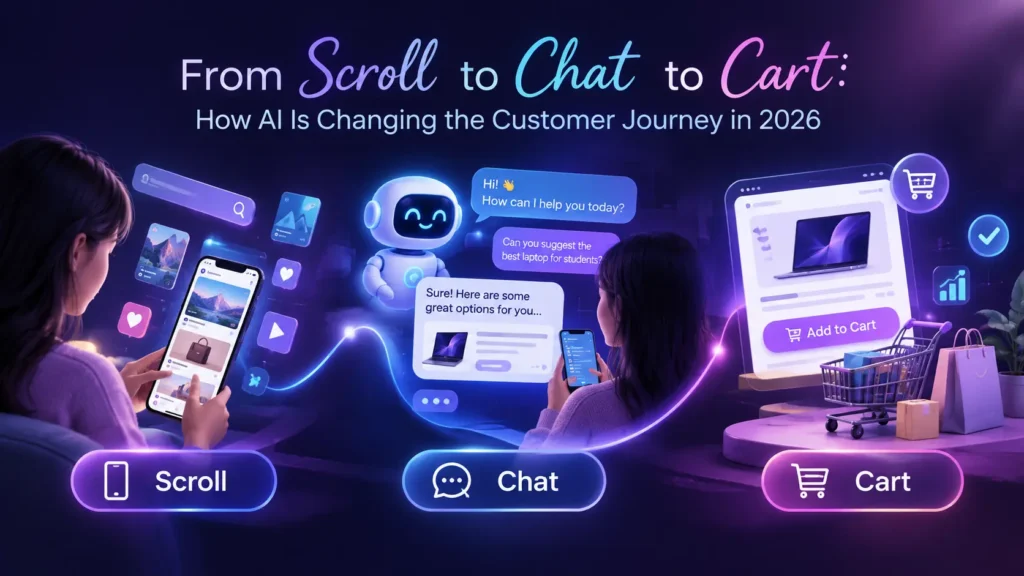
From Scroll to Chat to Cart: How AI Is Changing the Customer Journey in 2026

From Scroll to Chat to Cart: How AI Is Changing the Customer Journey in 2026 Novadigi Research Team 6 min read From feed discovery to instant messaging and streamlined checkout: AI connects every touchpoint of the modern customer experience. Think about your last online purchase. Did you sit at a desktop computer, type a product name into search, click the first link, and buy immediately? Probably not. More likely, your journey began while scrolling through your feed. You paused on a 15-second creator clip demonstrating a solution to an everyday problem. You skimmed comments, tapped a profile link, and watched a follow-up video. Later, an interactive message on WhatsApp answered questions about sizing and delivery. Before bedtime, you finalized the order in two quick taps. For business owners, this shift is profound. The traditional buying funnel—the predictable **Search → Website → Purchase** sequence—has dissolved. Today, the modern buyer follows a fluid path: Scroll → Discover → Watch → Ask → Chat → Compare → Trust → Buy At the center of this transformation is the **AI customer journey**. As we analyze key **AI marketing trends 2026** brings to digital commerce, artificial intelligence connects the dots across social media feeds, search engines, messaging apps, and checkout pages. Understanding how this connected journey works is essential for business growth. The Customer Journey Is No Longer Linear The **customer journey in 2026** is fluid, decentralized, and multi-directional. A buyer might discover your brand on Instagram Reels, watch a creator breakdown on YouTube Shorts, search your company on Google, read community reviews, ask questions via WhatsApp, and convert through a targeted email reminder. Shoppers discover, evaluate, and trust brands across diverse touchpoints: Instagram Reels and YouTube Shorts Creators and community reviewers Targeted social ads Search engines and AI answer overviews WhatsApp and direct messaging conversations Reviews and authentic user-generated content Consumers move between platforms before purchasing. Rather than expecting buyers to follow a rigid path, forward-thinking brands use **AI-driven marketing** to build responsive touchpoints that support prospects wherever they interact. From Scroll to Discovery — AI Is Changing What Customers See Discovery is no longer driven purely by search queries. AI recommendation systems predict consumer interest, introducing products before a shopper even thinks to search for them. Personalized Recommendations Algorithms analyze engagement signals—including watch time, repeat loops, and comments. Through sophisticated **AI personalization**, recommendation engines surface content tailored to individual lifestyles, helping brands connect with high-intent audiences with precision. Short-Form Video and Creators Short-form video is the gateway to modern discovery. When creators share authentic demonstrations or practical tips, they compress days of product research into thirty engaging seconds. In 2026, creator partnerships and **short-form video marketing** build buyer trust faster than traditional ads. This shift fuels the rapid rise of **social commerce**, where algorithmic feeds function as curated storefronts. Social Ads and Brand Visibility Organic reach alone rarely scales. Modern ad networks evaluate behavioral signals to display targeted offers. By connecting strategic [Internal Link: Paid SMM] campaigns with broader [Internal Link: Social Media Marketing] efforts, businesses place timely offers in front of users who have engaged with educational video content. From Discovery to Chat — Why Conversations Matter Discovery sparks curiosity, but hesitation follows. Questions about sizing, compatibility, delivery timelines, or return policies cause buyers to pause. In 2026, buyers rarely fill out static forms or wait days for email replies. They expect instantaneous, conversational clarity before spending their money. AI-Powered Conversations Modern **conversational commerce** uses intelligent chat assistants to answer common product inquiries, recommend matching items, and guide selections around the clock. However, automated tools work best with human oversight. Chat assistants should handle routine questions swiftly while allowing complex inquiries to transition smoothly to experienced team members. WhatsApp and Conversational Commerce For businesses in India and emerging markets, WhatsApp has evolved into a primary commercial channel. Direct messaging allows customers to explore product catalogs, ask questions, receive curated suggestions, and complete transactions inside a single chat window, bridging the gap from **social media to sales**. From Chat to Cart — How AI Can Reduce Purchase Friction When a customer is ready to buy, friction must be minimal. Modern **AI-powered shopping** workflows streamline checkout through practical tools: **Contextual Product Comparisons:** Smart widgets help shoppers evaluate options without leaving the product page. **Smart Offer Suggestions:** Automated systems suggest relevant bundles or free shipping thresholds right when hesitation occurs. **Predictive Retargeting:** Coordinated campaigns through [Internal Link: Google Ads] re-engage visitors with answers to common objections rather than repetitive ads. **Frictionless Checkout:** Streamlined mobile payments allow buyers to complete purchases in seconds. **Helpful Abandoned-Cart Reminders:** Timely follow-ups via WhatsApp or email address specific hesitations rather than sending generic discounts. Designing an end-to-end, **AI-powered customer experience** makes purchasing effortless without resorting to aggressive sales tactics. How AI Is Personalizing the Customer Experience Delivering a personalized **digital customer journey** means tailoring every stage of interaction based on customer intent. True **personalized marketing** extends far beyond inserting a subscriber’s first name into an email subject line. Content Using modern [Internal Link: Content Marketing] and flexible [Internal Link: CMS Solutions], brands serve educational guides to first-time visitors while showing returning customers relevant upgrades or reorder options. Advertising Machine learning optimizes ad creatives and bidding automatically, ensuring prospects see ad messages tailored to their level of brand familiarity. Recommendations Rather than showing random items, AI suggests complementary products based on actual purchase context—such as suggesting compatible memory cards and cases for a purchased camera. Follow-Ups Through automated [Internal Link: Email Marketing], businesses deliver helpful onboarding advice, care instructions, and warranty information that build long-term loyalty and enhance the overall **customer experience**. What This Means for Digital Marketing in 2026 Digital marketing cannot succeed in disconnected silos. Running social ads without coordinating with your website team or ignoring customer chat leads creates a disjointed experience that confuses prospective buyers. Success in 2026 requires connecting all key pillars: **SEO + SMM + Paid Ads + Content + Messaging + Analytics** When your [Internal Link: SEO Services], social storytelling, paid acquisition, and

Scroll to Top